Using a crypto signal safely means checking its record, sizing the trade, and setting the stop loss before you enter. As of 19 November 2026, Cryptonro has recorded 752 closed signals with a win rate of 82.0%, 614 wins and 138 losses. Past results do not predict future ones, so treat every signal as a trade you can afford to lose, not a promised outcome.
+16.0% on SKY/USDT, latest target hitJoin free ›Key takeaways
- As of 19 November 2026, Cryptonro's public record lists 752 closed signals: 614 wins and 138 losses.
- Risk a fixed small share of your account per trade, such as 1% to 2%, before you open any position.
- Set the stop loss before entry, not after the price moves against you.
- Cryptonro's average win is 5.1% and its average loss is -8.0%, so losses are part of the record.
- Bitcoin closed at $63,409 on 19 November 2026, down 12.39% over seven days, so market conditions matter.
- Free setups with an entry, a stop loss and targets are posted in the free Cryptonro Telegram channel.
Should I follow a crypto signals provider before checking its record?
Do not follow any provider before you have read its full record. Cryptonro's results are on the trade history page, where each closed signal shows its entry, close and result. As of 19 November 2026, the record holds 752 closed signals, with 614 wins and 138 losses, a win rate of 82.0%. Losses sit in the same list as wins, so you can see both. Check how results are calculated too: our method uses spot price moves from entry to close, equal size and no leverage. Before you join any channel, read the methodology and confirm the dates. If you want a step by step check, see how to verify a crypto signals Telegram channel. You can also join the free Telegram channel to see live setups before committing any money.
| Check | What to look for | Cryptonro figure |
|---|---|---|
| Win rate | Take profit closes divided by all closed signals | 82.0% (as of 19 November 2026) |
| Closed signals | Wins and losses shown together | 752 closed: 614 wins, 138 losses |
| Average win | Spot move from entry to close | 5.1% |
| Average loss | Spot move from entry to close | -8.0% |
| Profit factor | Gross wins divided by gross losses | 2.82 |
See how our setups are planned on the free crypto signals on Telegram page.
How much should I risk on one crypto signal?
Risk a small fixed share of your account on each signal, commonly 1% to 2%. Position size is the amount you buy, worked out from the distance between entry and stop loss. For example, with a £1,000 account and a 1% risk limit, you may lose £10 if the stop is hit. Use the crypto position size calculator to work this out before you enter. Cryptonro's average loss is -8.0% on the spot move, so a full position in a losing trade can cost more than you expect. Avoid leverage at first, because liquidation can close a position early. Keep a cash reserve so one bad run does not force you to trade bigger to recover. For the arithmetic, read how to calculate position size in crypto.

Five steps to act on a crypto signal. Diagram drawn from the steps in this article, not market data.
Want short daily notes like this? Join our free Telegram channel.
Where should I set the stop loss before I enter a signal?
Set the stop loss before you enter, and never move it further from the entry after the trade opens. A stop loss is the price where a trade closes automatically to limit a loss. Each Cryptonro signal lists an entry, a stop and up to five targets. Confirm the stop sits at a level you can accept in money terms, because the stop decides your position size. As a rule, if the stop is too far away to fit your risk limit, skip the trade. Our record shows five targets for the largest wins, such as the AVAX/USDT short from $9.22 to $7.74, a +16.0% spot move that hit 5 of 5 targets on 14 November 2026. Those wins came with a stop in place, which is why the stop matters as much as the target. Read more in stop loss in crypto.
What are the steps to act on a crypto signal?
Follow five steps in order: check the record, read the setup, size the trade, place the stop, then set targets. Start by confirming the signal is on the same pair and direction you expect. Next, check the entry price against the live market, because a signal can be stale by the time you read it. Bitcoin, for example, traded between $62,068 and $64,006 in the 24 hours to 19 November 2026, so a late entry can sit far from the original level. Then size the trade and place the stop order at once. Finally, take partial profit at the first target if your plan says so. For a fuller guide to the fields, read how to read a crypto signal. The free crypto signals on Telegram page shows recent target hits to compare against your own plan.

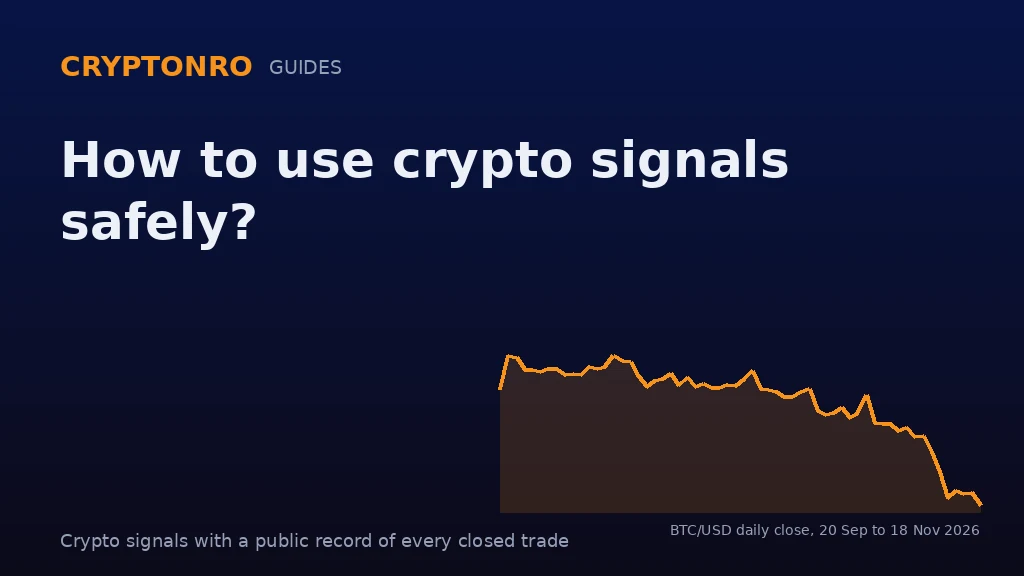
Bitcoin daily closing price, last 60 days. BTC/USD daily closing prices, 20 September 2026 to 18 November 2026. Source: Cryptonro price data. Past prices, not a forecast.
When does following crypto signals not work, and what are the risks?
Following signals does not work for everyone, and it can lose money. Crypto prices can fall fast. The Crypto Fear and Greed index stood at 10 of 100 (Extreme Fear) on 19 November 2026, a period when sharp moves are common. Other risks include fees, slippage where your fill differs from the signal price, leverage that magnifies losses, and liquidation. Past results do not predict future ones, and a high win rate can hide large losses on a few trades. Do not trade money you need for bills. Read the crypto risk disclosure before you act on any signal, and use signals as one input, not a replacement for your own judgement.
How do I avoid fake crypto signals channels?
Only trust signals from a channel whose record you can check, and be wary of anyone promising certain returns. The CFTC warns that scammers use social media to attract victims, and it advises caution with unsolicited offers. Check that a channel names its methodology, shows losses beside wins, and does not ask you to send funds to a private person. Cryptonro's free channel is open for reading, and the VIP plans are priced separately on the VIP crypto signals page. Never send coins to anyone who contacts you privately about a signal. Our verification guide lists the checks in order, and you can join the free Telegram channel to compare setups with the public record.